Marnie journal / Bills and subscriptions
How to Find and Track All Your Subscriptions
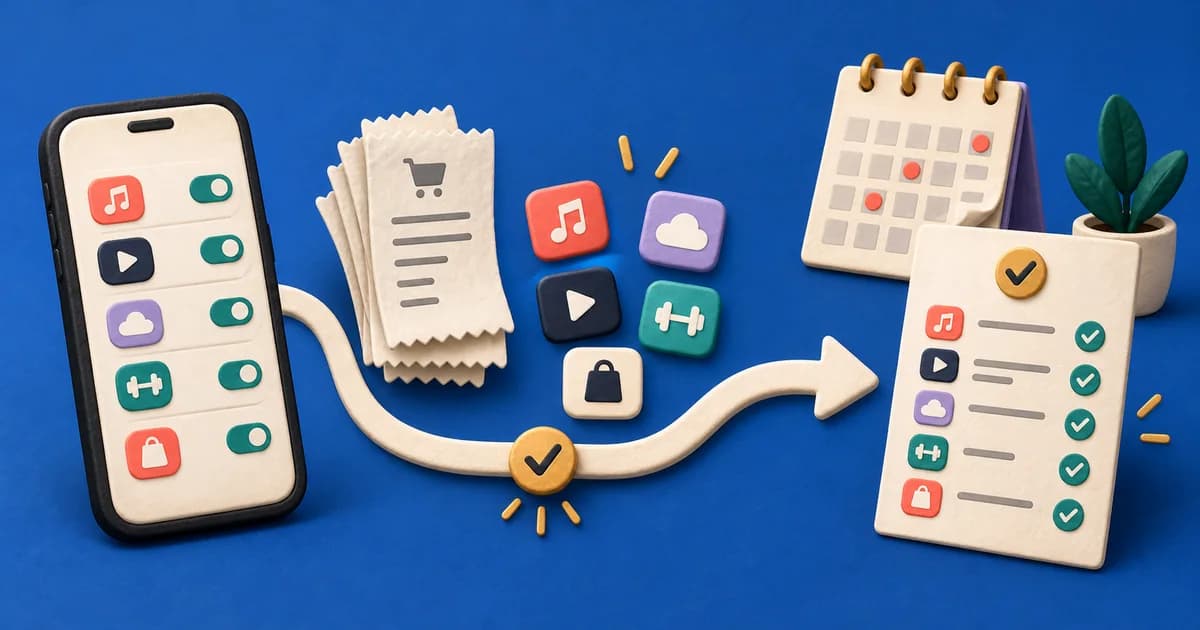
To find your subscriptions, combine bank and card statements, app-store subscription lists, provider accounts and email receipts into one list. Record each service's actual charge, billing frequency, next renewal and the company that bills you. Then decide what to keep and verify any cancellation with that company.
Your phone's subscription screen is a useful starting point. It is not a complete household subscription list. A streaming plan purchased on a website, a gym membership and an app billed through Google Play can all have different billing owners.
This guide gives you a reusable audit table and a worked example in Australian dollars. The example services and prices are invented, so you can focus on the method rather than changing product prices.
Start with the payment sources you actually use
Make a short checklist of your cards, bank accounts, app-store accounts and other payment services. Include accounts you stopped using recently, because an old account may still pay for a service you use on a new device.
For the first pass, inspect the last few statements for repeated merchants. For an annual audit, extend the review to 12 months and check upcoming renewal notices. A three-month window cannot reveal an annual charge that last occurred eight months ago. Even a year of statements can miss a new free trial, a multi-year plan or a membership that someone else in the household pays.
Use this coverage table to avoid treating one source as complete:
| Source | What to look for | What it may miss |
|---|---|---|
| Bank and card statements | Recurring charges, changing prices, unfamiliar billing names | Trials that have not charged yet; individual services inside a combined payment |
| Apple subscription list | Subscriptions attached to that Apple Account | Direct website purchases and other accounts |
| Google Play subscriptions | Subscriptions attached to that Google Account | Other Google Accounts and services billed elsewhere |
| Email receipts and renewal notices | Annual plans, upcoming trial conversions, the billing company | Messages in a different inbox or deleted receipts |
| Provider and household accounts | Plan details, bundles, who pays | Charges from services you forgot to check |
You can do this privately in a notebook or spreadsheet while reading statements yourself. You do not need to connect a bank account to another app. Our guide to expense tracking without bank linking compares the capture options if you want a longer-term record.
Check Apple and Google Play under the right account
On an iPhone, open Settings, tap your name, then Subscriptions. Apple's instructions also explain how to trace a missing subscription through an Apple receipt, another Apple Account or the company that actually bills you. A service bought through a mobile provider may need to be managed with that provider. Apple Support: If you want to cancel a subscription from Apple.
For Google Play, open the subscription list for the Google Account that made the purchase. If an expected service is absent, check your other accounts. Google explicitly says that uninstalling an app does not cancel its subscription. Google Play Help: Cancel, pause, or change a subscription.
Record the billing owner separately from the service name. For example, a fictional music app could be the service while Apple is the billing owner. The distinction tells you where to inspect the renewal or make a cancellation.
If a statement name is unfamiliar, compare the date and amount with receipts before assigning it to a subscription. A merchant's payment descriptor can differ from its public name. The guide to merchant-name errors in expense trackers explains why guessing from a label can produce a wrong category.
Build one subscription audit table
Use one row per subscription, not one row per place you found it. A receipt, an app-store entry and a bank debit can all describe the same membership.
Copy these fields into your preferred tool, or use the blank subscription table in our downloadable money-planning worksheets. The download is a Markdown document you can copy into a notebook, document or spreadsheet; it does not calculate totals automatically.
| Field | What to enter |
|---|---|
| Service and plan | The service you receive and the plan tier |
| Billing owner and account | Who charges you and which login owns it; never record passwords here |
| Actual charge and currency | The amount expected at each renewal, including known fees |
| Billing frequency | Weekly, monthly, annual or another exact interval |
| Next charge and review date | When money is due and when you will make a decision |
| Use and decision | What you use it for; keep, investigate, downgrade or cancel |
| Evidence and status | Receipt, renewal notice or cancellation reference; active, pending or ended |
A trial needs a row even if its current charge is zero. Record the future price and conversion date from its terms. For a variable charge, keep the latest known amount and label it as an estimate. Do not silently turn a forecast into a confirmed bill.
If two entries appear identical, establish whether they represent two plans or two records of one payment. The steps for resolving duplicate transactions apply before deleting either record.
Compare annual cost without losing the real renewal date
Monthly equivalents make different billing periods comparable. They do not change when money leaves your account.
| Billing interval | Annual comparison | Monthly equivalent |
|---|---|---|
| Monthly | charge x 12 | charge |
| Quarterly | charge x 4 | charge / 3 |
| Annual | charge | charge / 12 |
| Every four weeks | charge x 13 in a 52-week comparison | charge x 13 / 12 |
| Weekly | charge x 52 in a 52-week comparison | charge x 52 / 12 |
For weekly and four-week plans, check the actual renewal dates in the calendar period you are budgeting. A 52-week comparison is a consistent comparison basis, not an exact count of every calendar year's debits.
Here is an illustrative list of four services, all in AUD:
| Fictional service | Actual charge | Annual comparison | Monthly equivalent |
|---|---|---|---|
| Video plan | A$18 monthly | A$216 | A$18 |
| Cloud storage | A$48 annually | A$48 | A$4 |
| Fitness membership | A$15 every four weeks | A$195 | A$16.25 |
| Language app | A$90 annually | A$90 | A$7.50 |
| Total | Mixed billing intervals | A$549 | A$45.75 |
The cloud storage and language app have a combined monthly equivalent of A$11.50. If both renew this month, their actual debit is A$138. Putting A$11.50 into this month's cash-flow plan would understate the payment by A$126.50.
If your list contains different currencies, keep separate totals or choose and record a conversion rate and date. Do not add a US-dollar renewal to an Australian-dollar bill as though the currency labels were interchangeable.
Keep the cost comparison for deciding value and the renewal calendar for planning payments. For annual services you keep, a sinking fund for annual bills can spread the preparation across earlier paydays.
Make a decision based on use and commitment
Work through each row and ask what would happen if you stopped paying for it. A service used only occasionally may still matter. A low-cost service that no longer serves any purpose may be easy to remove.
Record one concrete decision:
- Keep: it serves a current need; retain the renewal and review dates.
- Investigate: the billing owner, price or household use is unclear.
- Downgrade or change: confirm the new price, effective date and any lost features before accepting.
- Cancel: follow the billing owner's process and save the result.
Do not assume the annual option saves money just because its monthly equivalent is lower. Compare the commitment with the months you expect to use the service. In a fictional A$12 monthly versus A$100 annual choice, six months of monthly access costs A$72. Twelve monthly payments cost A$144. The annual option costs less only if you need enough of the year and its terms suit you.
With a bundle, establish what remains after cancelling one component. With shared services, confirm who uses and pays for each plan before changing it. This keeps the audit grounded in your actual household rather than a generic list of subscriptions to cancel.
Confirm cancellations and measure the right saving
Make the cancellation with the service's billing owner. Save the confirmation, effective date, final expected charge and any access end date. Mark a request as pending until the provider confirms the outcome.
Cancelling a payment arrangement and ending a service contract can be separate actions. Moneysmart's Australian guidance distinguishes bank-account direct debits from recurring card payments and advises checking contract terms. Follow the relevant process rather than assuming a blocked payment ends your obligations. Moneysmart: Direct debits.
Measure the result in two separate columns:
| Result | How to record it |
|---|---|
| Future renewal avoided | The amount that will no longer be charged, starting from the confirmed effective date |
| Refund received | The actual amount returned when it appears in your payment record |
In the example above, cancelling the language app's next A$90 annual renewal lowers the continuing annual comparison from A$549 to A$459. It does not create an A$90 cash inflow today. Google Play's guidance says that after cancellation you generally retain access for the period already paid; refunds have their own rules. Google Play subscription guidance.
Check the payment source after the next expected renewal. If a charge continues, compare it with the confirmed end date and contact the billing company with the evidence. Keep the transaction visible while resolving the issue.
Keep the list current between audits
Update the list when you start a trial, accept a price change, switch plans or cancel. Review upcoming renewals with your regular money check. A future renewal should remain visible even when no payment alert arrives this week.
Automatic transaction capture can help you notice an actual charge, but it is not proof of complete subscription coverage. A price change notice or an uncharged trial needs a separate review. Marnie's planned bills, subscription tracking and reviewable expense capture are intended to support that habit. Marnie is currently in early access; it does not promise to discover or cancel every subscription for you.
Start with the services due before your next pay and extend the list through the year. If you want to follow Marnie's development, join the early-access list.
Platform and consumer guidance checked on 13 September 2026. Billing rules depend on the provider and plan; use the terms attached to your subscription.
Coming soon · iPhone and Android
Track expenses without linking your bank.
Marnie brings supported payment capture, text and voice entry, and Safe to Spend planning together. Join the list for launch news and first-access details.

Marnie Editorial
Practical explanations for a calmer relationship with everyday money. Marnie provides informational guidance, not financial advice. Read our research and corrections policy.