Marnie journal / Expense tracking
How to Track Cash Expenses Without Double Counting
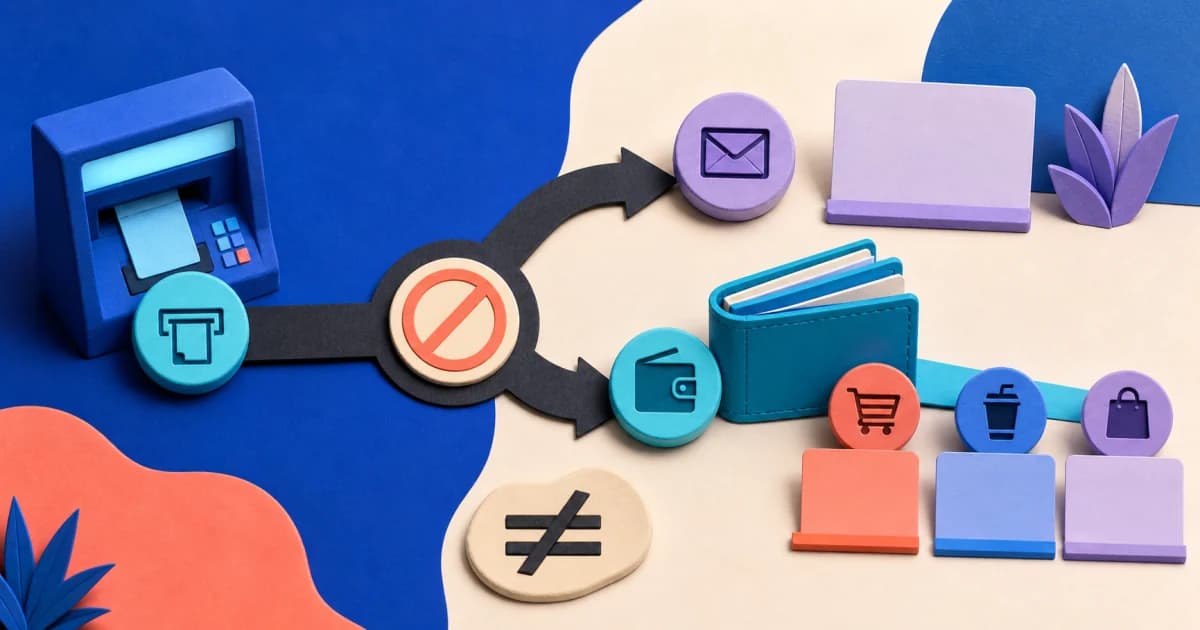
To track cash expenses accurately, choose one method: record the ATM withdrawal as spending, or treat it as a transfer and itemise each cash purchase. Never count both the withdrawal and the purchases as expenses, because that records the same money twice.
On this page
- Why cash needs its own workflow
- Compare the two methods
- See a no-double-counting example
- Reconcile cash on hand
- Handle common exceptions
- Combine cash with automatic capture
- Frequently asked questions
Why does cash need its own expense-tracking workflow?
Cash breaks the direct link between a bank transaction and the final purchase. Your statement can show a $100 ATM withdrawal, but it cannot show whether the notes later paid for lunch, transport, groceries, a gift, or nothing yet.
The Reserve Bank of Australia's 2025 Consumer Payments Survey found that cash made up about 15% of consumer payments. People logged every payment for seven days. The result describes that survey period, not every Australian purchase (RBA, Consumer Payment Behaviour in Australia).
Moneysmart recommends including cash purchases when you track daily spending because they are easy to forget (Moneysmart, Track your spending). The goal is not perfect memory. It is a clear rule that makes your totals meaningful.
Should you record the cash withdrawal or each cash purchase?
Both methods can work, but they answer different questions. Pick one for each pool of cash and use it consistently.
| Method | How to record the ATM withdrawal | How to record purchases | Best for | Main limitation |
|---|---|---|---|---|
| Withdrawal as spending | Record the full withdrawal as a "Cash spending" expense | Do not add later purchases as expenses | Fast awareness of how much leaves the bank as cash | Weak category detail and timing; unspent notes look spent |
| Cash wallet plus itemised purchases | Record a transfer from the bank account to a cash wallet | Record each purchase against the cash wallet | Category accuracy, purchase dates, and cash-on-hand balance | More entry and reconciliation work |
Method 1: record the withdrawal as spending
This method treats cash as an envelope that is spent for budgeting purposes when you withdraw it. A $100 withdrawal becomes one $100 cash expense. The coffee, bus fare, and market purchase paid from those notes do not become additional expenses in the tracker.
Choose this when you want a ceiling on cash taken from the bank and do not need item-level categories. Label it "Cash spending" or "Cash envelope" rather than guessing categories. If $60 remains at month-end, the method still reports the full $100 in the withdrawal period.
Method 2: treat cash as an account and itemise purchases
This method creates a cash wallet in your records. Moving $100 from your bank to the wallet is a transfer, not an expense. Spending occurs only when you record a purchase against that wallet.
Choose this when you want real purchase categories and dates. It also shows how much cash should remain. Use it only if you can maintain it consistently.
If you want to compare capture choices beyond cash, see how to track spending without linking a bank account.
Worked example: withdraw $100 and spend $67
Assume you start with no cash, withdraw $100, then make these purchases:
- lunch: $25
- bus fares: $10
- market groceries: $32
- cash left in the wallet: $33
With the withdrawal-as-spending method, record one $100 cash expense. Do not record the $67 of purchases again. Your spending report shows $100, even though $33 remains physically unspent.
With the cash-wallet method, record the $100 ATM event as a transfer from Bank to Cash. Then record three expenses totalling $67 against Cash. The cash wallet balance becomes $33, which matches the notes remaining.
The double-counting error is to record a $100 expense at the ATM and another $67 of expenses at purchase time. That produces $167 of reported spending even though only $67 has actually been paid to merchants and $33 remains.
If you started with the withdrawal method and later decide to itemise, reclassify or reverse the original $100 cash expense before adding the individual purchases. Do not leave both versions in the reporting period. The same principle applies when fixing duplicate expense-tracker transactions: identify the two records that represent one economic event, then keep the representation that matches your chosen method.
How do you reconcile a cash wallet?
Cash reconciliation compares the balance your records predict with the notes and coins you actually hold. Use this equation:
Cash received includes withdrawals, income, refunds, and reimbursements. Cash paid out includes purchases, deposits back to the bank, and money moved to another cash pool. These movements affect the wallet balance even when they are not income or expenses in your spending report.
Count your cash once a week, on payday, or at month-end. The US Consumer Financial Protection Bureau suggests two simple methods. You can save receipts and total them weekly or monthly. You can also use a notebook to record every expense (CFPB, Assess your spending). This is general record-keeping advice, not Australian tax or regulatory guidance.
Follow these steps:
- Start with the closing balance from your last cash count.
- Add ATM withdrawals, cash-back amounts, income, refunds, and reimbursements received in cash.
- Subtract cash purchases, bank deposits, gifts, and transfers out of this cash pool.
- Count the actual notes and coins.
- Compare actual cash with the expected closing balance.
Suppose your record says $42, but you count $38. The shortage is $4. Check recent receipts and obvious gaps first.
If you cannot find the cause, add a $4 "Cash adjustment" expense. Include a note and the date of the cash count. A visible adjustment is more honest than an invented coffee purchase. Count cash more often if a difference is large or keeps returning.
Bank data alone cannot show where cash was spent. The Australian Bureau of Statistics faces this gap in its household spending indicator. The indicator mainly uses credit and debit card transactions. The ABS makes a separate cash adjustment using ATM withdrawals and payment survey evidence (ABS, Interpreting the Monthly Household Spending Indicator). A personal tracker has the same limit. An ATM event shows that cash moved, not where each note went.
How should you handle cash refunds, income, fees, and shared purchases?
Use the same account logic for exceptions so the balance and spending report stay aligned.
Cash refunds
If a shop returns $20 in cash for an earlier card purchase, add $20 to the cash wallet. Record it as a refund against the original category where your system supports that link. It reverses earlier spending, so do not call it new income.
Cash income
Record cash wages or other income into the cash wallet with a clear source. Do not label every cash inflow as earnings: a refund reverses a purchase, a transfer moves existing money, and a reimbursement returns money you paid for someone else. A personal record of those movements does not determine their tax treatment. Keep any separate records needed for tax, work, or a dispute.
ATM fees
Separate the cash from the fee. Suppose the statement shows a $100 withdrawal and a $3 ATM fee. Under the wallet method, move $100 into Cash and record the $3 as a bank-fee expense. Under the simple method, record $100 as cash spending and $3 as a fee. Do not add the later purchases under that method.
Shared cash purchases
Keep the full cash movements and make your personal share clear. Suppose you start with $100, pay $60 in cash for a shared meal, then receive $30 back in cash. These illustrative entries preserve both the wallet balance and the cost of your share:
| Event | Cash movement | Cash balance | Personal dining total |
|---|---|---|---|
| Opening wallet | $100 | $0 | |
| Pay for the meal | -$60 | $40 | $60 before reimbursement |
| Receive the other person's share | +$30 | $70 | $30 after reimbursement |
Record the returned $30 against the meal or the original category where supported, rather than as salary. If the other person repays you into your bank account, the cash wallet stays at $40 and the bank receives $30. A net $30 dining entry alone would hide that split between accounts.
Money moved between cash pools
Moving money between travel, household, or personal cash envelopes is a transfer. Record spending only when the money pays for something. Moneysmart's How to do a budget guidance recommends including regular expenses, savings, debt payments, and irregular costs.
How can cash tracking work with automatic expense capture?
Automatic capture and cash entry should complement each other. Card or payment notifications can reduce typing for eligible electronic transactions, while cash remains a manual exception. Review the limitations of an Android notification expense tracker before assuming every bank alert is a final expense.
Use these controls in a hybrid workflow:
- Mark an ATM withdrawal as a transfer if you use the itemised cash-wallet method.
- Exclude cash purchases from manual entry if you use the withdrawal-as-spending method.
- Check whether both a bank alert and a manual entry represent the same ATM event.
- Keep pending transactions separate until the amount settles.
- Record refunds and reversals against the original expense where possible.
- Reconcile the bank account and cash wallet independently.
For fast entry at the point of purchase, voice expense tracking can reduce typing. Check the amount and category on screen before you save. Marnie supports spoken and typed entry for missed transactions. Its automatic capture methods also stay open to review. Whatever tool you use, keep one stable rule for transfers and purchases.
Frequently asked questions
Is an ATM withdrawal an expense?
It depends on your tracking method. Treat it as an expense only under the simple withdrawal method. If you itemise cash purchases, the withdrawal is a transfer into a cash wallet.
What category should I use for a cash withdrawal?
Use a broad "Cash spending" category only when the withdrawal itself is your chosen expense record. Under the cash-wallet method, use no expense category because it is a transfer.
What if I cannot remember a cash purchase?
Check receipts and recent activity, then record a clearly labelled cash adjustment if the physical count still differs. Do not invent a merchant or category that you cannot support.
How often should I reconcile cash?
Weekly is a practical starting point, with another check at the end of the budget period. Reconcile more often if cash use is frequent or mismatches are hard to explain.
Can a bank feed categorise cash spending?
It can identify the withdrawal, but not the merchants or purposes of later cash purchases. Item-level cash categories require receipts, memory, or entry at purchase time.
Should I keep cash receipts?
Keep receipts when you need proof for returns, warranties, reimbursement, tax, or disputes. An expense entry is a useful personal record but may not satisfy those other purposes.
Pick one rule and make it visible
Cash tracking becomes reliable when every event follows a visible method. Use the withdrawal method for simplicity or the cash-wallet method for detail. Reconcile on a schedule and label unexplained differences honestly.
Coming soon · iPhone and Android
Track expenses without linking your bank.
Marnie brings supported payment capture, text and voice entry, and Safe to Spend planning together. Join the list for launch news and first-access details.

Marnie Editorial
Practical explanations for a calmer relationship with everyday money. Marnie provides informational guidance, not financial advice. Read our research and corrections policy.